Whitepaper: The CUI Endpoint Control Guide
A four-layer framework for hardening, managing, and evidencing every device that touches Controlled Unclassified Information
Executive summary
Every protection a defense contractor promises for Controlled Unclassified Information (CUI) is delivered, or broken, on a device: the laptop in a home office, the workstation on a shop floor, the phone that syncs project mail. NIST Special Publication (SP) 800-171 makes those devices the government's business, and DFARS clause 252.204-7012 makes implementing it a current contractual obligation, independent of any assessment schedule. Enforcement is active now: in September 2026 the Department of Justice announced a settlement of over $2 million with Honeywell Aerospace Inc. resolving False Claims Act allegations of failing to comply with NIST SP 800-171 on a network covered by a Department of Defense contract.
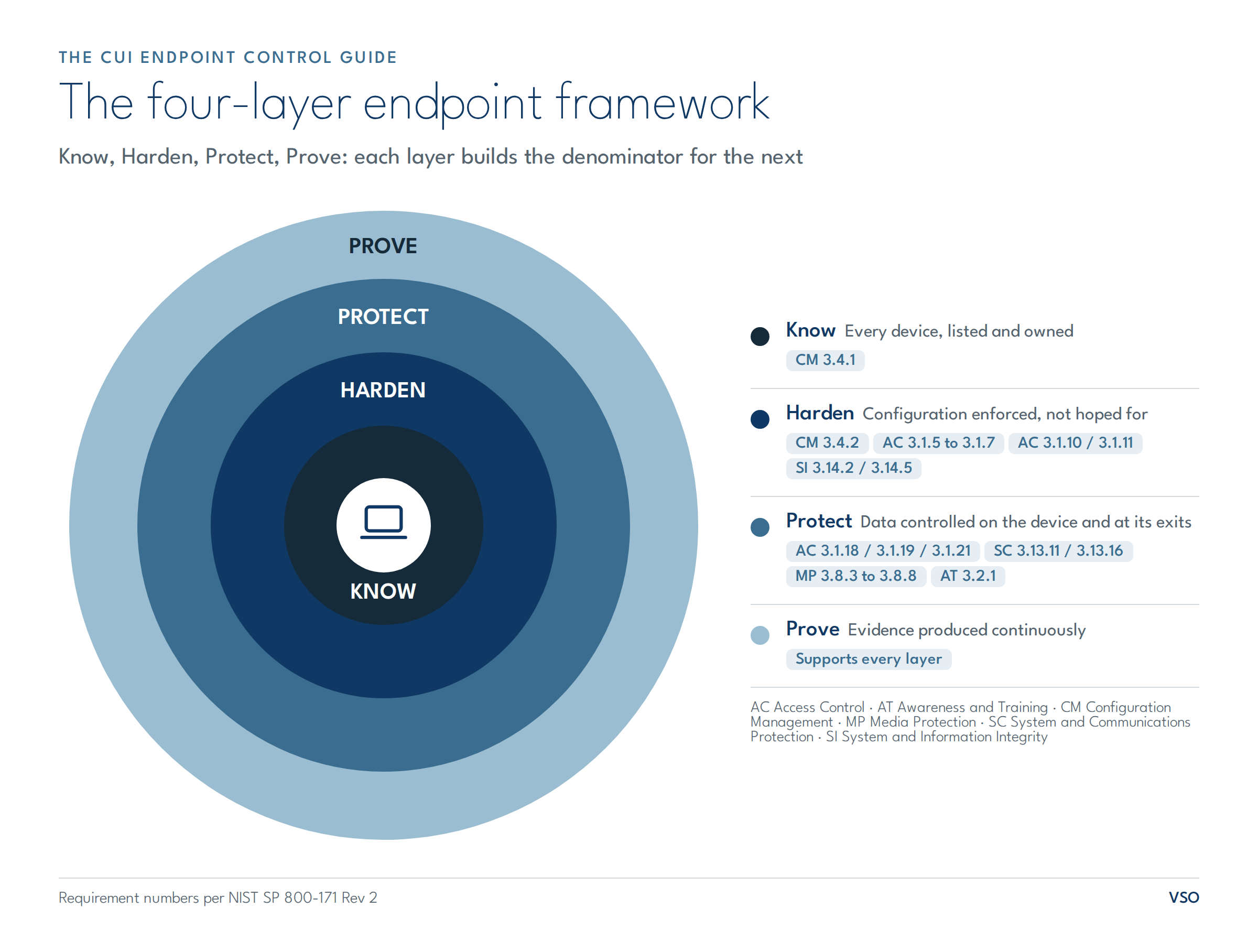
This guide gives IT and security leaders a four-layer framework for endpoint control in a CUI environment: Know every device, Harden every configuration, Protect the data on and through the device, and Prove it continuously. Each layer maps to specific NIST SP 800-171 Rev 2 requirements and ends with actions a small team can sequence without enterprise tooling budgets. The paper closes with a control checklist that pairs each requirement with the artifact that evidences it. The thesis throughout: endpoint hardening in a regulated environment is not a project with an end date; it is an operating discipline whose byproduct is the evidence your contracts already oblige you to have.
1. The endpoint is where CUI protection succeeds or fails
An endpoint program in the Defense Industrial Base answers one question: can you show, for every device that touches CUI, that the controls your System Security Plan (SSP) describes are actually enforced on it, today? Everything else in this guide serves that answer.
The obligation is contractual and current. Contracts carrying DFARS 252.204-7012 require implementation of NIST SP 800-171 on covered contractor systems, and the recent movement in Cybersecurity Maturity Model Certification (CMMC) assessment timing did not change those underlying requirements; assessment schedules and contractual security obligations are different things. The enforcement mechanism has teeth independent of assessments: the False Claims Act. The September 2026 Honeywell Aerospace settlement, which resolved allegations that a business unit failed to comply with NIST SP 800-171 on a covered network between 2020 and 2023, began with a whistleblower, not an assessor. The settlement resolves allegations only, with no determination of liability, and its lesson is procedural rather than technical: the gap between what a contractor claims and what its systems enforce is now a litigation surface.
Regulatory surface of this guide: NIST SP 800-171 Rev 2 requirements as detailed in the CMMC Level 2 assessment guidance; DFARS 252.204-7012 as the contractual driver; FIPS 140 validation where cryptography protects CUI confidentiality. Outside this guide's scope: identity and access architecture (privileged access, MFA design, conditional access); network and enclave architecture; and any statement about a specific assessment timeline, which should be verified against DoD sources at the time of reading.
2. Layer one: Know. You cannot protect a device you cannot list
The inventory is the root control, and NIST SP 800-171 Rev 2 makes it explicit: requirement 3.4.1 requires baseline configurations and inventories of organizational systems, maintained through the development life cycle. Every other endpoint control inherits its denominator from this one. Encryption coverage, EDR coverage, patch compliance: each is a fraction, and the inventory is the bottom of it.
What Layer one requires in practice: a single authoritative device list with owner, platform, and CUI role for each entry; reconciliation, monthly at minimum, across the three systems that each believe they know your fleet (the directory, the management platform, the security tooling); a defined intake path so new devices enter the inventory before they enter service; and a leaver process that ends devices' lives deliberately. The reconciliation is the control with the highest yield per hour spent: a device present in the directory but absent from management is an unmanaged CUI risk you did not know you had, and finding it costs one query.
Scope discipline belongs to this layer too. A device is in scope when it processes, stores, or transmits CUI or provides security protection for one that does, and ownership is irrelevant to that test. Personal phones syncing project mail are Layer one entries like any other, which is an argument for deciding deliberately where CUI may land rather than inventorying the consequences afterward.
Actions: build the reconciliation query before buying anything; assign every device an owner in writing; date-stamp the inventory export monthly and keep it, because a dated series of inventories is itself assessment evidence.
3. Layer two: Harden. Configuration is a promise; enforcement is the control
Hardening means the device's configuration is decided centrally, enforced automatically, and checked continuously, rather than documented once and hoped for. The framework language is direct: requirement 3.4.2 requires establishing and enforcing security configuration settings, and the access control family adds the session disciplines users notice, including session lock with pattern-hiding displays (3.1.10) and automatic session termination (3.1.11). The System and Information Integrity family contributes malicious code protection at entry and exit points with real-time and periodic scanning (3.14.2, 3.14.5), the modern form of which is endpoint detection and response (EDR) deployed to the whole inventory, not the convenient subset.
Three hardening decisions do most of the work in a small contractor environment. First, baselines: adopt a published benchmark for each platform, deviate deliberately and in writing, and enforce through your management platform so drift is corrected rather than merely reported. Second, local administrator rights: a user who can reconfigure the device can unwind every other layer, so administrative access on CUI endpoints should be the exception, logged, and reviewed; this is also where least-privilege requirements (3.1.5 through 3.1.7) become concrete at the device. Third, patching cadence: define it, measure it against the inventory, and treat the stragglers list as a standing agenda item, because the unpatched five percent is where incidents start.
Contractors running Microsoft 365 GCC High should plan hardening around the government cloud's own documentation for management and security tooling, since feature availability and service endpoints differ from commercial; our October post on Intune and Defender for Endpoint in GCC High covers the differences that affect planning.
Actions: pick the benchmark, enforce it centrally, remove standing local admin, and publish an internal patch scorecard by device every month.
4. Layer three: Protect. Control the data on the device and through its exits
Layer three assumes a hardened device and asks where the CUI on it can go. The requirements concentrate in two places: encryption and media.
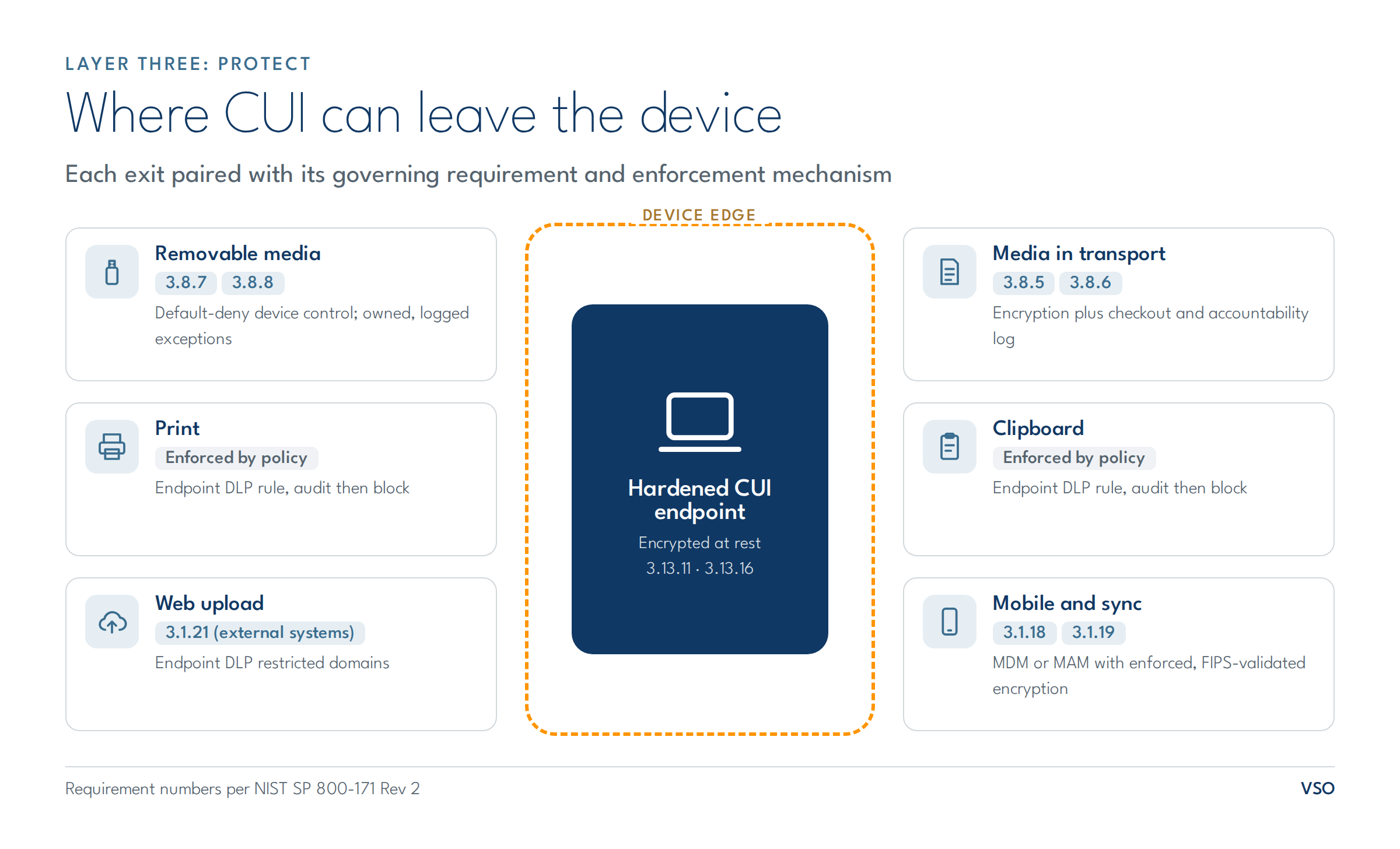
Encryption first. Requirement 3.1.19 requires encrypting CUI on mobile devices and mobile computing platforms, and requirement 3.13.16 protects CUI at rest more broadly. Because this cryptography protects CUI confidentiality, requirement 3.13.11 raises the bar to FIPS-validated cryptography. The operational trap is the difference between encryption being switched on and the FIPS-validated configuration being active and verifiable; the second is what the requirement means, and your management platform should report it per device.
Media and egress next. The Media Protection family is short and testable: control removable media on system components (3.8.7); prohibit portable storage with no identifiable owner (3.8.8); protect CUI on media in transport cryptographically or physically (3.8.6); keep accountability for media leaving controlled areas (3.8.5); sanitize before disposal (3.8.3). Requirement 3.1.21 limits your portable storage on external systems, and 3.1.18 controls mobile device connections. Nothing here bans USB drives or personal phones; everything here demands the use be deliberate, owned, encrypted, and logged. Complete prohibition is a recognized implementation and is easier to evidence; a default-deny model with a small set of owned, encrypted, logged exceptions preserves the workflows manufacturing and engineering genuinely need. Endpoint data loss prevention tooling is how several of these requirements become configuration rather than trust, enforcing and logging USB, print, upload, and clipboard behavior at the device; our October post on endpoint DLP for CUI covers the rollout pattern.
The user layer belongs here too, framed honestly. Requirement 3.2.1 obliges security awareness training, and the useful version is specific to how CUI actually moves in your shop rather than generic caution. Design controls so a distracted user on a Tuesday afternoon cannot create an incident with one click, then train for the residue the controls cannot catch.
Actions: require per-device FIPS-mode encryption reporting; default-deny removable media with logged exceptions; pilot endpoint DLP in audit mode on the CUI classification; decide the BYOD question deliberately and write down the answer.
5. Layer four: Prove. Evidence as a byproduct, not a fire drill
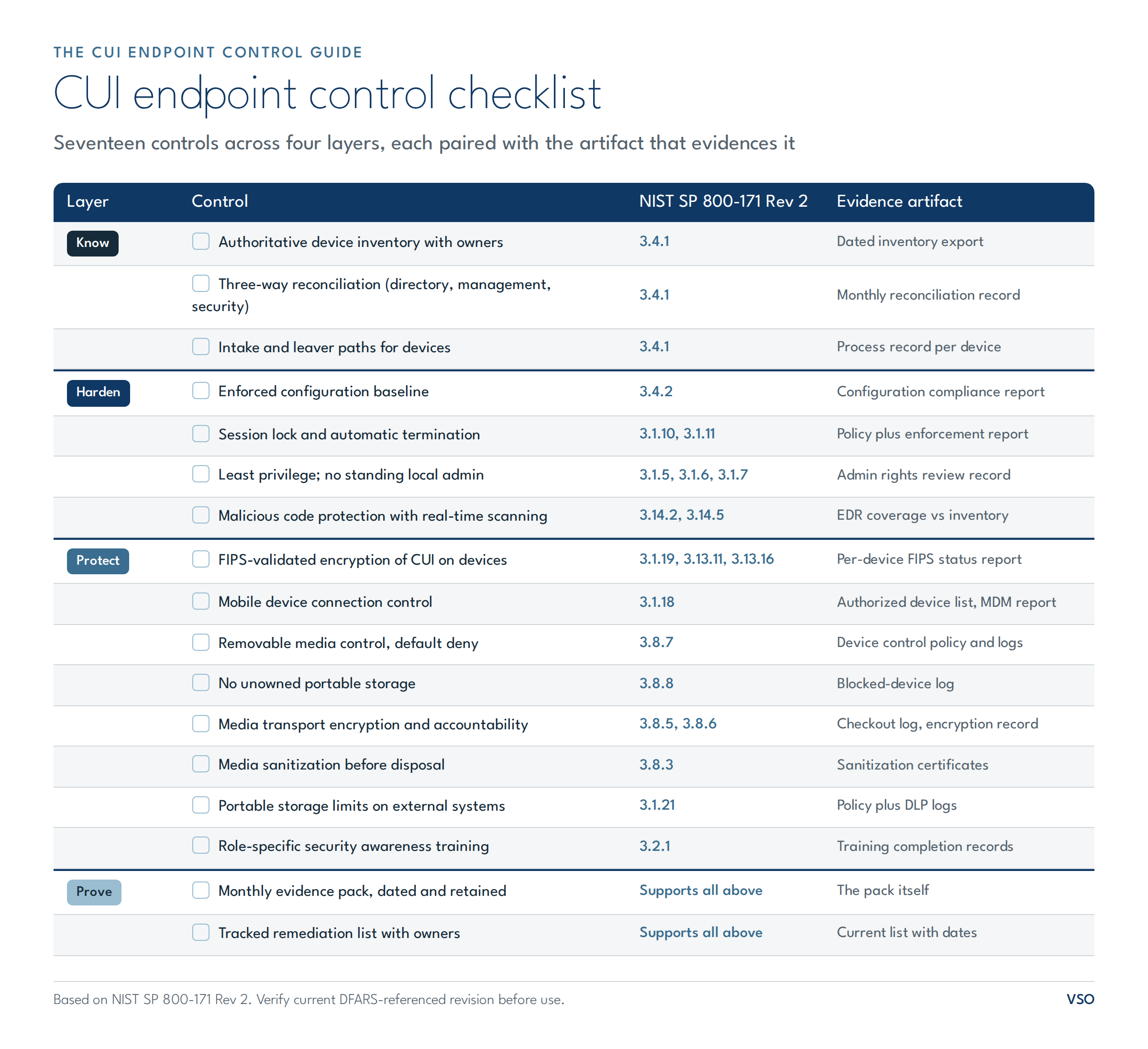
If the first three layers run as designed, the fourth is nearly free: continuous reporting that turns operations into artifacts. The pattern to institutionalize is the requirement-to-artifact pair. An inventory requirement pairs with a dated export and reconciliation record; a configuration requirement pairs with the compliance report from the platform that enforces it; the encryption requirement pairs with the per-device FIPS status report; media controls pair with the DLP and device-control logs; malicious code protection pairs with EDR coverage measured against the inventory. Your SSP should describe the mechanism, and the report should be producible the day someone asks: an assessor, a prime flowing down requirements, an insurer, or counsel.
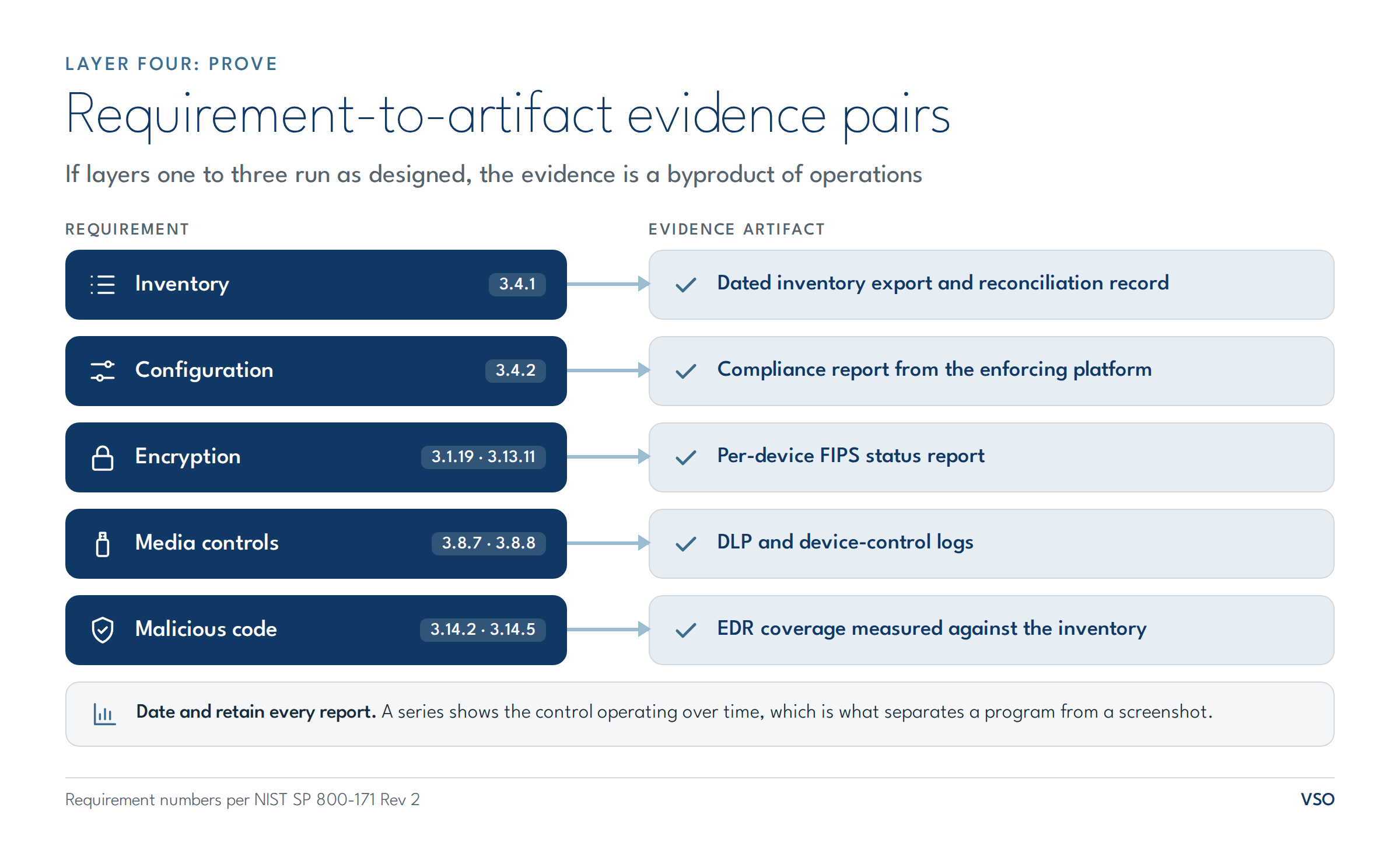
Two disciplines keep Layer four honest. Reports must be dated and retained, because a series shows the control operating over time, which is what distinguishes a program from a screenshot. And every gap the reporting reveals goes onto a tracked remediation list with an owner, because a known, tracked, resourced gap is a defensible posture, while an unknown one is the Honeywell fact pattern.
This is also the layer where a managed services relationship changes the economics for a small contractor: continuous monitoring and reporting is the day job of a provider like VSO, and the evidence accumulates as a side effect of operations rather than as a quarterly scramble.
6. Recommendations: the ninety-day sequence
Sequenced for a small team, each step building the denominator for the next. First month: build the authoritative inventory and the three-way reconciliation; assign device owners; write the intake and leaver paths. Second month: adopt and enforce configuration baselines on the highest-CUI-exposure device group; remove standing local administrator rights; turn on per-device encryption and FIPS-mode reporting. Third month: implement default-deny removable media with logged exceptions; pilot endpoint data loss prevention in audit mode; publish the first monthly evidence pack (inventory export, configuration compliance, encryption status, EDR coverage) and put a recurring date on producing the next one. From day ninety onward, the program is the monthly pack plus the remediation list, reviewed by someone with the authority to fund fixes.
VSO runs endpoint programs inside CUI environments for Defense Industrial Base contractors, from inventory to evidence pack. If you want the ninety-day sequence executed with you rather than by you, talk to our team.
Contact us today at sales@vso-inc.com or visit our contact page to start the conversation.
FAQ
Appendix: The CUI endpoint control checklist