GovCloud day-2 operations: what breaks after the migration

The migration retrospective is the last time most government cloud environments get everyone's full attention. Six months later the baseline has drifted, two new accounts are logging to nowhere, someone has designed around a service that does not exist in the region, and the monthly bill has a slope nobody owns. None of this shows up as an incident. It shows up as an environment that no longer matches its own system security plan. This piece is a teardown of the five ways GovCloud and Azure Government environments degrade after go-live, and what a functioning operating model does about each.
Why do government cloud environments degrade after go-live?
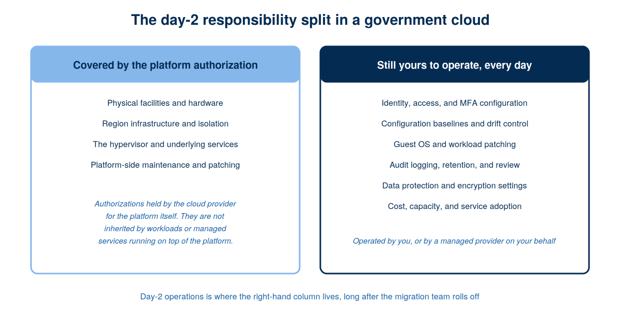
Because the platform authorization covers the platform, and everything else is a continuous operating obligation that nobody re-scoped after the migration team rolled off. AWS operates the GovCloud (US) regions and Microsoft operates Azure Government; their authorizations cover the facilities, hardware, and underlying services. They do not cover your identity configuration, your baselines, your logging, or your data protection settings, and a workload or managed service running on the platform does not inherit the platform's authorizations.
Migration projects are staffed to reach the customer side of that split. Day-2 operations is the discipline of staying there, and it is the half of the shared responsibility model with no finish line. The staffing usually follows the same pattern: the migration had a project team, and day 2 has whoever was left standing, which is how patch windows slip and reviews stop happening without anyone deciding they should.
Feature and region gaps surface after the migration, not during it
Migrations move known workloads onto verified services, so parity problems mostly wait until day 2, when someone tries to adopt a service that is unavailable in the region, or available with different behavior or endpoints. Service availability and feature parity between commercial and government regions differ and change over time, in both directions.
The operating habit that fixes this is boring and cheap: check the vendor's own comparison documentation before committing a design to a service, and keep a short parity watchlist for services the roadmap depends on. Treat it works in commercial as a hypothesis, not a fact about your region.
Patching and configuration drift do not pause for staffing gaps
A verified baseline starts decaying the day it is established. NIST SP 800-171's configuration management family (3.4) expects established baselines and controlled change, and in a cloud estate the mechanics are golden images or infrastructure as code for the baseline, drift detection that alerts on deviation, and a change process that leaves records rather than Slack threads.
Unmanaged drift is a double loss. The posture weakens, and the environment stops matching the system security plan that describes it, which converts an engineering problem into a documentation finding at the same time. The test worth running quarterly is simple: pick three systems at random and compare their live configuration to the documented baseline. If the diffs surprise you, the drift program is aspirational.
Log like you will be asked to prove it
The audit and accountability family (3.3) is a day-2 workload, not a checkbox from the landing zone build. Centralize logs across every account and subscription, define retention deliberately, and make review actually happen rather than theoretically possible. The classic silent gap: an account or subscription created after the migration, outside the original logging design, generating nothing. Retention deserves a named number and an owner, because the default in most services is shorter than anyone assumes, and the moment you need the logs is precisely the moment you cannot recreate them.
Done properly, logging is also where continuous evidence comes from. An environment whose logs, access reviews, and change records accumulate as a byproduct of operations walks into any assessment with its artifacts already written.
Cost and capacity behave differently in government regions
Government-region pricing carries a premium over commercial and the service catalog is narrower, so capacity planning and a monthly cost review are operating controls, not finance chores. The recurring failure is sizing decisions imported from commercial assumptions: instance families that do not exist in the region, reservation strategies never revisited, and workloads left running because nobody owns turning things off.
A monthly review that pairs the bill with the asset inventory catches most of it, and the inventory is a document the security requirements expect you to keep anyway. The same review is where service adoption gets governed: new services enter the environment through the parity check and the change process, not through an afternoon experiment that becomes production by Friday.
If the environment has not had a deliberate operating review since cutover, run one on a 90-day cadence: baseline and drift status, logging coverage against the account list, the parity watchlist, and cost against inventory. Four agenda items, one afternoon, and most of what breaks in year one gets caught while it is still small.
VSO operates Azure Government and AWS GovCloud environments for defense contractors as a managed service, with drift control, logging, and evidence generation as part of the operating model rather than an annual scramble. If your environment has not had an operating review since cutover, book one.