MSP vs MSSP: which one a regulated organization actually needs

The MSP vs MSSP question usually comes up after something goes wrong. An alert fires overnight, the IT provider says security is handled by someone else, the security provider says it cannot touch the affected server, and the incident waits while two companies sort out who acts. For regulated organizations, that gap is the real issue. This post explains the difference between a managed service provider (MSP) and a managed security service provider (MSSP), why regulated organizations usually need both functions, and how to structure them so nothing falls between.
What is the difference between an MSP and an MSSP?
An MSP runs and maintains your IT environment, while an MSSP monitors that environment for threats and helps respond to them. The MSP keeps systems working: service desk, endpoints, patching, backup, networks, and cloud infrastructure. The MSSP keeps watch: security monitoring, alert triage, threat investigation, and incident support, often through a 24×7 Security Operations Center (SOC).
The National Institute of Standards and Technology (NIST) National Cybersecurity Center of Excellence (NCCoE) describes MSPs as organizations that “deliver services, such as network, application, infrastructure and security, via ongoing and regular support.” That definition already includes security, which is why the line between the two categories blurs in practice.
| MSP | MSSP | |
| Primary job | Operate and maintain IT | Detect and respond to threats |
| Typical services | Service desk, endpoints, patching, backup, network, cloud | Monitoring, alert triage, threat hunting, incident support |
| Hours that matter most | Business hours plus on-call | Around the clock |
| Key tools | Remote management, endpoint management, ticketing | Security information and event management (SIEM), endpoint detection and response (EDR) |
| Measured by | Uptime, ticket resolution, patch compliance | Detection coverage, triage quality, escalation speed |
Why do regulated organizations usually need both?
Regulated organizations usually need both because their obligations cover both keeping systems configured correctly and knowing when something goes wrong. Frameworks such as NIST SP 800-171 Rev 2 and the Health Insurance Portability and Accountability Act (HIPAA) Security Rule include operational requirements (configuration, patching, backup) and security monitoring requirements (audit logging, incident handling). One provider type alone rarely covers both well.
The more important point is that the two functions depend on each other. An MSSP that detects a compromised laptop needs someone with administrative access to isolate it. An MSP that deploys a new server needs the MSSP to start collecting its logs. When those handoffs cross company lines, every one of them becomes a contract question.
Where the gap between an MSP and an MSSP causes trouble
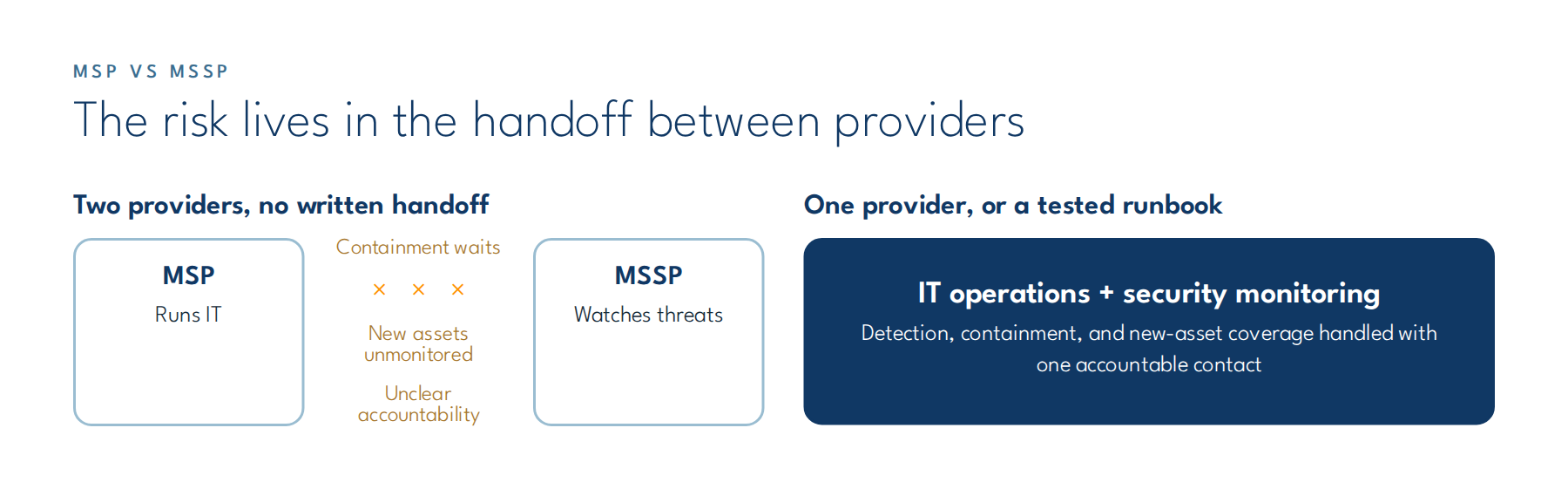
The gap causes trouble in three places: containment, visibility, and accountability.
- Many MSSPs monitor and advise but do not have rights to change your systems. Response waits until the MSP acts.
- New devices and cloud resources added by the MSP stay invisible to the MSSP until someone tells it. Monitoring coverage drifts.
- After an incident, each provider can point to the other’s scope. Your organization is left to reconstruct what happened.
Attackers know this. NCCoE notes that “MSPs have become an attractive target for cyber criminals,” because a weakness at the provider reaches every customer that depends on it. Clear access controls and logging on both providers matter as much as the services they deliver.
How to structure MSP and MSSP services
Structure the two functions so that one party owns the handoff between them. There are two workable models.
The first is a single provider that delivers both functions under one team. Detection and containment happen inside one organization, monitoring coverage updates when the environment changes, and one contact is accountable. VSO works this way: Managed IT Services and Managed SOC Services are delivered by VSO together, coordinated by a named service delivery manager for each client.
The second is two providers with a written integration. If you keep separate providers, require a shared runbook that states who isolates devices, who changes firewall rules, how new assets are added to monitoring, and how incidents are documented. Test it with a tabletop exercise at least once a year.
Either model can work. What fails is two providers with no written handoff. For more on how operations and security centers divide work, see our comparison of NOC vs SOC.
How to evaluate providers in the MSP vs MSSP decision
Evaluate providers on how they handle the handoff, not only on their service lists. Ask each one:
- Who has the authority to isolate a compromised device at 2 a.m.?
- How are new systems added to monitoring, and how quickly?
- Can we see the same alerts and tickets your team sees?
- How does your team secure its own access to our environment?
- Who writes the incident record, and what does it contain?
The answers show whether a provider has run both functions in practice or only describes them.
Pay attention to the first question in particular. A provider that answers “we notify you” rather than “we isolate it, then notify you” is describing a monitoring service, not a response service. That can be the right choice, but only if someone on your side or at your MSP is ready to act at that hour, with the access and authority to do it. Write that person’s name into the runbook.
Choosing between MSP vs MSSP
The MSP vs MSSP choice is rarely either-or for a regulated organization. You need systems run well and threats caught early, and the handoff between those two jobs is where incidents stall. Choose one provider that does both, or write the handoff down and test it.
Want IT operations and security monitoring under one accountable team? Contact us today at sales@vso-inc.com or talk to VSO about Managed SOC Services.